
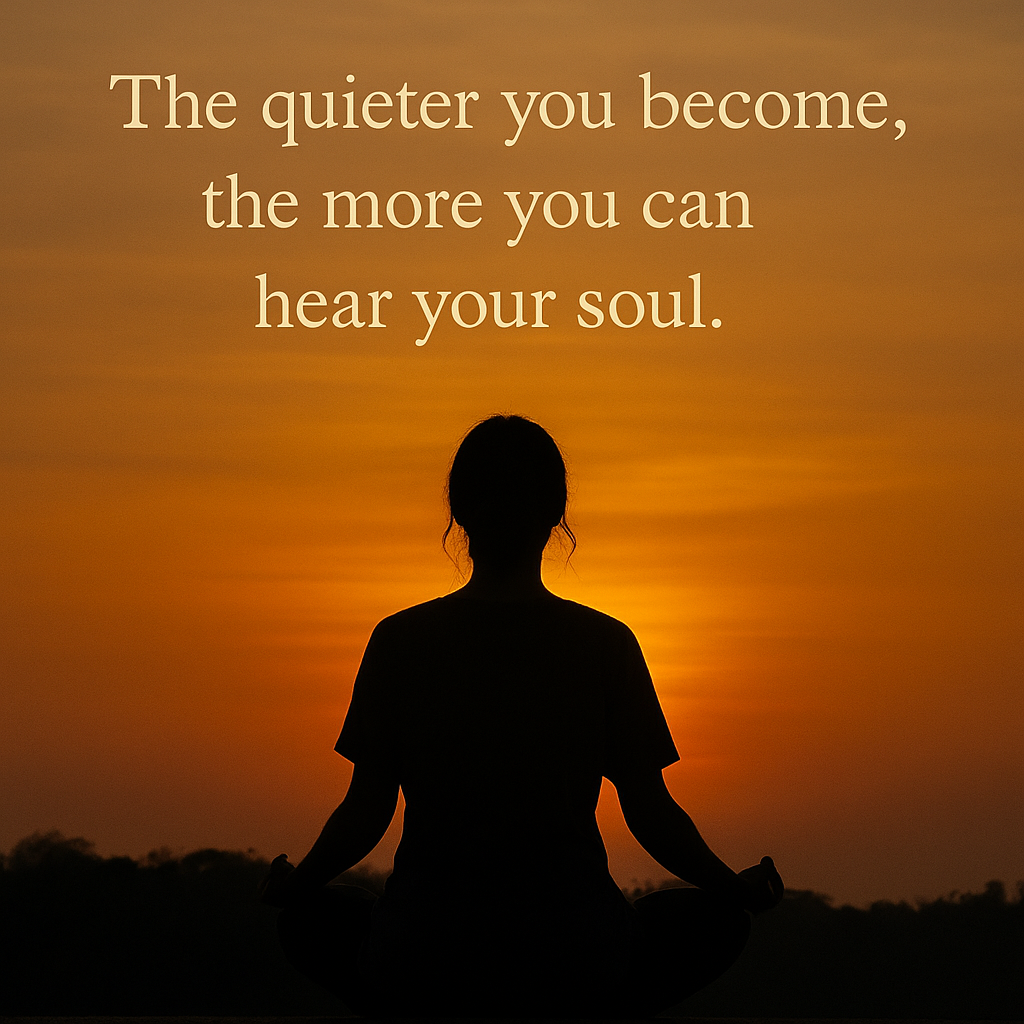
The Quieter You Become, the More You Can Hear Your Soul
Introduction
In a world overflowing with noise — notifications, opinions, endless scrolling — silence has become a rare luxury.
Yet, hidden within stillness lies a profound truth: “The quieter you become, the more you can hear your soul.”
This quote, often attributed to Buddhist teachings and spiritual philosophers, reminds us that peace and clarity don’t come from adding more, but from removing distractions.
When the mind quiets, the heart speaks. When the noise fades, the soul begins to whisper.
In this article, we’ll explore what it truly means to “hear your soul,” why silence is essential for self-understanding, and how you can cultivate inner quiet in your daily life.
We’ll blend insights from psychology, philosophy, and spirituality — and by the end, you’ll understand why silence is not emptiness, but the space where meaning is born.
The Meaning Behind the Quote
At its essence, the quote speaks about inner awareness.
To “hear your soul” means to connect with your authentic self — your deepest values, desires, and intuition.
But modern life constantly drowns that inner voice.
Every time we pick up our phone, argue with strangers online, or rush from one task to another, we distance ourselves from our inner truth.
The quote suggests that quietness is not just external silence, but internal stillness — a calm mind that listens rather than reacts.
“Silence is the language of the soul. All else is translation.” — Rumi
When you become quiet, you stop trying to control or label everything.
You begin to feel instead of just think.
That’s when the voice of your soul — your intuition — becomes clear.
The Science of Silence
Modern science supports what ancient wisdom has known for centuries: silence changes the brain.
According to a 2013 study by neuroscientist Imke Kirste at Duke University, two hours of silence per day led to the growth of new brain cells in the hippocampus, the region associated with memory, emotion, and learning.
Silence:
- Reduces cortisol (the stress hormone)
- Improves focus and creativity
- Balances the nervous system
- Strengthens emotional regulation
In essence, silence rewires the brain for calmness and insight.
When your mind is still, the prefrontal cortex — the part responsible for self-awareness — becomes more active.
That’s when deep intuition and reflection appear.
So, when you quiet the external world, you awaken the internal one.
The Noise That Blocks the Soul
Before we can listen to the soul, we must understand what silences it.
1. External Noise
The obvious kind — traffic, phones, news, notifications.
This constant stimulation keeps the nervous system in fight-or-flight mode, making true reflection impossible.
2. Mental Noise
Even in a quiet room, the mind can shout:
“What if I fail?”
“Why did they say that?”
“What will happen tomorrow?”
This inner chatter — judgment, worry, comparison — is often louder than any external noise.
3. Emotional Noise
Unresolved pain, guilt, or fear can cloud perception. When we refuse to face our feelings, they become static that blocks inner wisdom.
The soul doesn’t shout — it whispers. That’s why stillness is needed to hear it.
Silence in Spiritual Traditions
Across every major tradition, silence has been revered as sacred.
1. Buddhism
Meditation is the art of becoming silent enough to witness the mind.
Through mindfulness, one learns to let go of thoughts — not by fighting them, but by observing them.
In that observation, the soul’s peace emerges.
2. Christianity
In the Bible, silence is a space for divine encounter.
“Be still, and know that I am God.” — Psalm 46:10
Saints and monks throughout history retreated into quiet contemplation to hear the “still, small voice” within.
3. Sufism and Rumi
Rumi taught that silence is the highest language.
When words end, the soul begins to sing.
He said, “The quieter you become, the more you are able to hear.”
4. Native and Indigenous Traditions
Many indigenous cultures see silence as wisdom.
In the quiet of nature, elders taught that the earth itself speaks — to those willing to listen.
Across all paths, silence is not emptiness — it’s communion.
Listening to the Soul in a Modern World
So, what does it mean today to “hear your soul”?
In modern terms, it’s about reconnecting with your authentic self in a world that constantly tells you who to be.
Your soul is the part of you untouched by trends or fears. It’s the inner compass that knows your truth.
But to hear it, you must turn down the noise.
Signs You’re Hearing Your Soul
- You feel calm, even when things are uncertain.
- You know what’s right for you without overthinking.
- You act from love, not fear.
- You feel aligned — your choices match your values.
Signs You’re Disconnected
- Constant anxiety or restlessness.
- Living to please others.
- Feeling numb or lost.
- Ignoring your emotions.
The quieter you become, the easier it is to distinguish your soul’s voice from the noise of the ego.
The Ego vs. the Soul
The ego shouts; the soul whispers.
- The ego says: “You’re not enough.”
- The soul says: “You already are.”
- The ego seeks approval.
- The soul seeks peace.
- The ego fears silence.
- The soul lives in it.
When we silence the ego — the constant need to prove, defend, and compare — we discover a deep inner stillness.
That stillness is not weakness; it’s strength beyond measure.
“In the silence of the heart, God speaks.” — Mother Teresa
Practical Ways to Hear Your Soul
1. Practice Daily Silence
Set aside 10–15 minutes each day to simply sit quietly. No phone, no music, no talking.
Observe your breath and thoughts.
At first, your mind will resist — that’s normal. Keep returning to your breath.
2. Journal with Intention
Write down what your soul might be trying to tell you.
Ask questions like:
- What do I truly want?
- What am I avoiding?
- What does peace look like to me?
Writing slows the mind and reveals patterns.
3. Spend Time in Nature
Nature has no agenda — it just is.
Walking among trees or sitting by the sea synchronizes your rhythm with the earth’s quiet pulse.
4. Disconnect to Reconnect
Take regular digital detox days.
The fewer voices you absorb from the internet, the more your inner voice will rise.
5. Listen Without Judgment
Your soul speaks through feelings, dreams, and intuition.
If sadness comes, let it teach you.
If joy comes, let it expand you.
Every emotion is a message, not a mistake.
Silence as Healing
Many spiritual healers believe that silence itself has energetic healing power.
When you rest in silence, your nervous system resets.
Your body leaves survival mode and enters restoration.
In that space, old wounds surface — not to hurt you, but to be released.
You begin to understand your life from a higher perspective.
Silence doesn’t ignore pain — it transforms it.
Like still water reflecting the sky, a quiet mind reflects truth.
“Within you there is a stillness and a sanctuary to which you can retreat at any time.” — Hermann Hesse
The Relationship Between Silence and Creativity
Many great artists, writers, and inventors discovered their best ideas in silence.
Einstein loved to walk alone for hours. Beethoven found inspiration in quiet nature.
Creativity doesn’t come from thinking harder — it comes from listening deeper.
When you quiet the analytical mind, intuition flows.
That’s why silence is not the absence of sound; it’s the presence of awareness.
If you’re a creator, meditate before you create.
The ideas that come from stillness often carry a spark of timeless truth.
Silence and Relationships
Listening to your soul also improves how you relate to others.
When you’re internally quiet, you no longer need to dominate conversations, win arguments, or prove your worth.
You begin to listen with empathy, not just ears.
True communication begins with inner stillness.
Couples who practice mindfulness together report deeper emotional connection and less conflict.
Silence creates space for understanding — and understanding is love in action.
When Silence Feels Uncomfortable
For many people, silence is scary.
It exposes the emotions we’ve buried — loneliness, fear, regret.
But those feelings are not enemies; they are invitations to healing.
If silence feels painful at first, stay with it gently.
Breathe through it.
The discomfort is the ego dissolving.
On the other side of that unease lies peace beyond words.
The Soul’s Voice: Intuition
When you become quiet enough, intuition begins to speak.
It’s that gentle inner knowing that guides you toward what feels right — even if logic disagrees.
The soul doesn’t argue; it simply knows.
Listening to your intuition is the most practical form of spirituality.
It’s the GPS of your higher self.
Examples:
- You suddenly feel inspired to call someone — and they needed you.
- You sense a situation is wrong — and later, realize why.
- You feel drawn to a new path — and it transforms your life.
That’s not coincidence; that’s your soul speaking.
The Connection Between Silence and Gratitude
When we quiet the noise of complaints and comparisons, gratitude naturally arises.
In silence, you notice small miracles — your breath, sunlight, the rhythm of life itself.
Gratitude deepens awareness and invites joy.
Every moment becomes sacred when seen through a quiet heart.
“Silence isn’t empty; it’s full of answers.” — Unknown
The Modern Challenge: Finding Quiet in Chaos
You don’t need a monastery to practice silence — just intention.
Even in a busy city, you can create small sanctuaries of peace.
Try:
- Turning off music while driving.
- Eating one meal in silence daily.
- Sitting for five minutes before sleep without your phone.
Silence isn’t about isolation — it’s about presence.
You can be surrounded by people yet still deeply still inside.
The Spiritual Meaning of Hearing Your Soul
Hearing your soul means remembering who you are beneath the layers of identity — not your job, status, or appearance, but your essence.
It’s the moment when you realize:
- You are not your thoughts.
- You are not your emotions.
- You are the awareness behind them.
That awareness — timeless and calm — is what spiritual teachers call the soul, the self, or consciousness.
To live from that place is true freedom.
Silence and Enlightenment
Many mystics reached enlightenment through deep silence.
In Zen Buddhism, the awakening moment (satori) often occurs when the mind becomes completely still.
The mind says: “I must find peace.”
The soul says: “Be still — peace is already here.”
When you hear your soul, you stop seeking and start being.
That’s the difference between existing and living awake.
Practical Daily Routine for Soul Connection
Here’s a simple, modern way to integrate silence into your daily life:
| Time | Practice | Duration |
|---|---|---|
| Morning | 5-minute breathing silence before checking your phone | 5 min |
| Afternoon | Walk without music or talking | 10–15 min |
| Evening | Write one line of gratitude and one self-reflection | 5 min |
| Weekly | One “silent hour” — no devices, no media | 60 min |
Over time, silence becomes your natural state — a quiet strength you carry everywhere.
Quotes That Resonate With This Truth
“In the stillness of the mind, I saw myself as I am — unbound.” — Sri Nisargadatta Maharaj
“All man’s miseries derive from not being able to sit quietly in a room alone.” — Blaise Pascal
“Be silent, only the hand of God can remove the burdens of your heart.” — Rumi
“Quiet the mind, and the soul will speak.” — Ma Jaya Sati Bhagavati
Each of these echoes the same wisdom: the quieter you become, the clearer life becomes.
Conclusion
In silence, you rediscover your true nature.
The quote “The quieter you become, the more you can hear your soul” isn’t about escaping life — it’s about awakening within it.
When you learn to listen to your soul, every challenge becomes a lesson, every emotion a teacher, and every moment a meditation.
The world will always be noisy. But peace isn’t found by running away — it’s found by going inward.
Silence is not the absence of sound; it’s the presence of yourself.
“Within you is a stillness and a sanctuary to which you can retreat at any time.” — Hermann Hesse
So today, take a breath.
Turn down the volume of the world.
And listen — your soul has been waiting to speak.