Tears Are How the Heart Speaks When the Mouth Can’t Explain the Pain
Introduction
There are moments in life when words simply fail.
No language, no sentence, no explanation can fully describe what the heart feels.
In those moments, the body finds another way to speak — through tears.
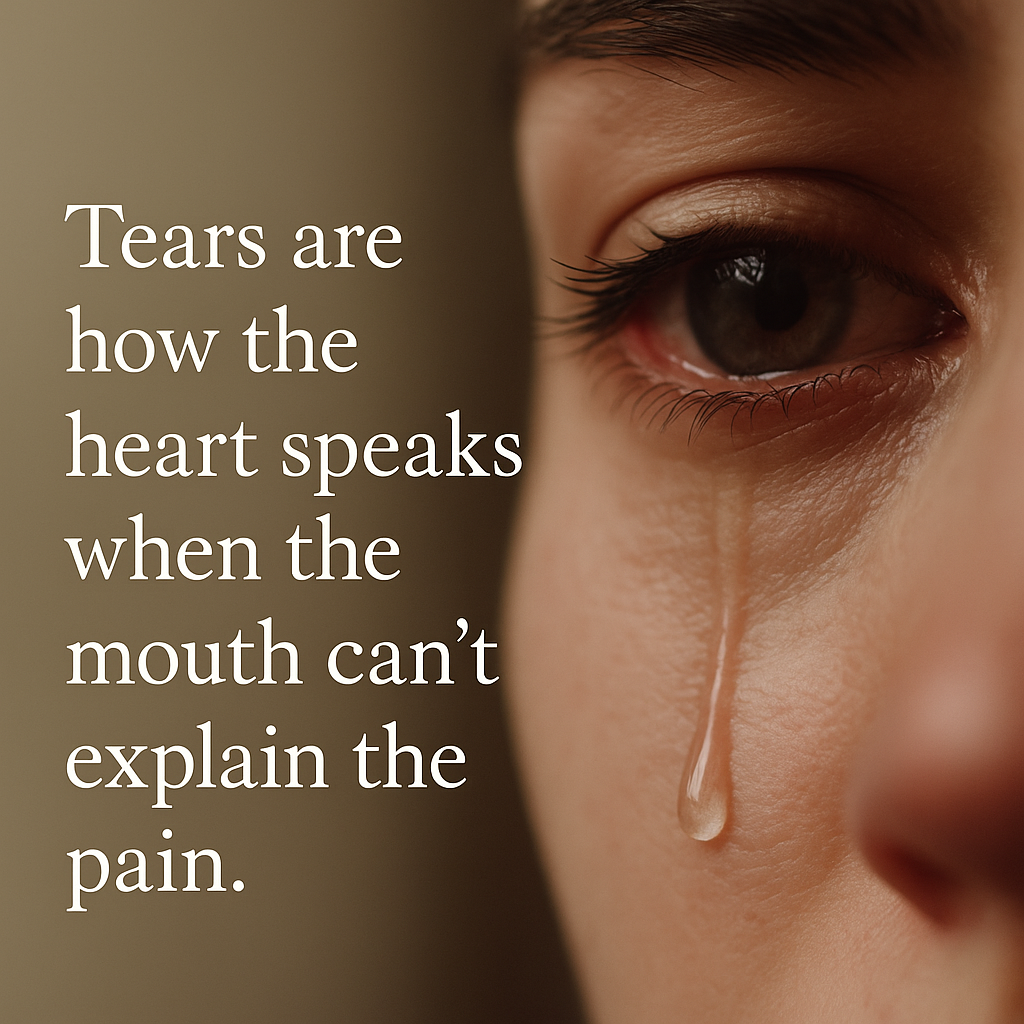
The quote “Tears are how the heart speaks when the mouth can’t explain the pain” captures the essence of emotional truth. It reminds us that crying is not weakness; it’s communication — the language of the soul when silence carries the heaviest meaning.
In this article, we’ll explore the psychology, spirituality, and beauty of tears — why they exist, what they reveal about human strength, and how they heal wounds that words never could.
The Hidden Power of Tears
Tears are not random drops of water; they are biological poetry — a fusion of emotion, chemistry, and healing.
Every tear tells a story: of loss, love, regret, or relief.
Science shows that crying is a complex emotional response that releases stress hormones and restores balance. But beyond the science, tears are symbolic expressions of the human condition — they show vulnerability, authenticity, and connection.
“There is a sacredness in tears. They are not the mark of weakness, but of power.” — Washington Irving
When we cry, the heart opens. The emotional armor falls away. In that moment, we are raw, honest, and profoundly human.
When Words Fail, Feelings Speak
The Limits of Language
Language is powerful, but it has limits.
No matter how skilled a person is with words, some experiences lie beyond verbal description — the death of a loved one, a heartbreak, a silent disappointment, or the feeling of being misunderstood.
Pain often lives in silence because the mind cannot translate the magnitude of emotion into sound.
That’s where tears come in — they express what cannot be said.
The Body as a Messenger
The heart doesn’t speak in words; it speaks in sensations.
A tight chest, trembling hands, tears running down your face — these are messages.
Your body becomes your translator when your mind can’t organize pain into sentences.
That’s why crying feels like both breaking and healing at the same time. It’s the body’s way of saying, “I am overwhelmed, but I am releasing.”
The Science of Crying: Healing Through Emotion
Psychologists have long studied the link between crying and emotional health.
According to research by Dr. William Frey, emotional tears contain stress hormones like cortisol and prolactin. When we cry, the body literally removes chemical toxins related to tension and anxiety.
Crying is therefore not just emotional — it’s biological self-cleansing.
Benefits of crying include:
- Emotional release: It helps reset the nervous system.
- Stress relief: Tears lower blood pressure and heart rate.
- Connection: Crying in front of someone builds trust and empathy.
- Healing: It restores emotional equilibrium after trauma or grief.
So when you cry, your heart isn’t just expressing pain — it’s beginning to heal it.
Different Types of Tears
Most people don’t realize that not all tears are the same. There are three types, each serving a unique purpose:
- Basal Tears – Constantly produced to keep the eyes moist.
- Reflex Tears – Triggered by irritants like smoke or onions.
- Emotional Tears – Caused by deep feelings, releasing hormones and providing relief.
Only emotional tears contain endorphins and stress-related chemicals — a natural therapy gifted by biology.
So yes, crying really does make you feel better — not just emotionally, but physically.
Tears and the Language of the Heart
“The soul would have no rainbow had the eyes no tears.” — John Vance Cheney
When we cry, the heart speaks in a universal language.
No translation is needed — everyone understands tears.
They bridge emotional distances between people, revealing our shared vulnerability.
Tears are truth. They bypass logic and ego, showing what words often hide.
A single tear can say:
- I miss you.
- I’m sorry.
- I can’t hold it in anymore.
- Please understand me.
In that sense, tears are the purest form of honesty.
Crying as Strength, Not Weakness
Society often teaches us that crying is weakness — especially for men or leaders. But this belief couldn’t be further from the truth.
To cry means to feel deeply, and feeling deeply is a mark of strength, not fragility.
It takes courage to face emotions instead of suppressing them.
“Crying doesn’t mean you’re broken. It means you’ve been strong for too long.” — Johnny Depp
Suppressing pain may seem like control, but it’s actually avoidance. Emotional suppression builds walls that disconnect us from ourselves and others.
Allowing tears to flow, however, brings emotional freedom and inner peace.
Cultural Views on Tears
Throughout history, tears have held profound symbolic meanings across cultures.
In Ancient Greece
Philosophers saw tears as the soul’s purification — an act of cleansing spiritual pain.
In Christianity
Tears represent repentance, compassion, and divine grace. Saints and mystics often described crying during prayer as spiritual renewal.
In Japanese Culture
Crying is seen as a way to release accumulated emotion — a “tear cleanse” for the heart.
In Middle Eastern Traditions
Tears during mourning rituals symbolize solidarity and emotional sincerity.
Across cultures, tears are a bridge between the human and the sacred — the visible mark of invisible emotion.
The Psychology of Emotional Expression
Psychologists describe crying as emotional regulation — the body’s natural process for balancing feelings.
When you hold back tears, you prolong distress. When you release them, you restore emotional clarity.
Dr. Judith Orloff, author of The Empath’s Survival Guide, calls tears “the body’s release valve for stress, sadness, grief, anxiety, and frustration.”
They keep us emotionally clean — just as rain clears the sky.
In other words, crying is emotional hygiene.
The Healing Role of Tears in Grief
When we lose someone or something important, the heart breaks open.
No words can fully describe the void. Tears become the only voice capable of carrying the depth of that pain.
Grief has no timeline. Sometimes it returns unexpectedly — triggered by a song, a smell, or an anniversary.
And each time, the heart speaks again — through tears.
Crying allows us to integrate loss into life, not erase it.
It transforms raw pain into remembrance, and remembrance into love.
Tears and Empathy: When One Person’s Pain Touches Another
When you see someone cry, it stirs something inside you.
That’s empathy — the heart recognizing another heart’s pain.
Shared tears can connect strangers.
A friend’s tears can heal your silence.
A child’s tears can awaken compassion in the hardest heart.
Crying together dissolves emotional walls, creating intimacy.
It’s not weakness to comfort someone crying — it’s sacred witnessing.
“Those who do not weep, do not see.” — Victor Hugo
Tears allow us to see with the heart, not just the eyes.
Tears in Love and Relationships
In relationships, tears often emerge during moments of misunderstanding, forgiveness, or emotional depth.
When someone cries in front of you, they are not just showing sadness — they are showing trust.
To cry before another person is to say, “I am showing you my truth without fear.”
Couples who allow emotional expression tend to form stronger bonds.
Crying together can heal resentment and rebuild emotional intimacy.
So instead of feeling embarrassed by tears in love, see them as proof of emotional honesty — the heart saying what words can’t.
The Spiritual Meaning of Tears
Beyond science and psychology, tears carry deep spiritual symbolism.
Many spiritual teachers describe crying as the soul’s release — a moment when the divine within us meets human vulnerability.
When you cry during meditation, prayer, or reflection, those tears are not of sadness but of awakening.
They wash away illusion and connect you to your higher self.
In Sufi mysticism, tears are seen as “pearls of the heart” — signs of divine longing.
In Buddhism, crying often marks moments of compassion — when one feels the suffering of others deeply.
Tears, in essence, are a bridge between human emotion and spiritual truth.
When You Can’t Cry
Some people struggle to cry — even when they feel pain.
This doesn’t mean they lack emotion; it often means they’ve learned to suppress it as a survival mechanism.
If you find it hard to cry:
- Try journaling or creative writing.
- Listen to emotional music or movies that open your heart.
- Practice mindfulness to connect with your body’s sensations.
- Allow yourself to feel without judgment.
Sometimes, tears come not from sadness but from finally feeling safe to let go.
Tears as Transformation
Crying doesn’t just express pain — it transforms it.
When tears fall, something heavy lifts.
They turn grief into acceptance, anger into forgiveness, and chaos into clarity.
After crying, notice how your breathing slows, your body softens, and your thoughts quiet down.
That’s the alchemy of emotion — tears turning pain into peace.
“Sometimes, crying is the only way your eyes can speak when your mouth can’t explain how broken your heart is.” — Unknown
The more you honor your tears, the more your heart heals.
The Connection Between Art, Music, and Tears
Artistic expression is deeply linked to tears.
Songs, poems, and paintings often make people cry — not because they are sad, but because they touch something true.
When music moves you to tears, it’s your soul resonating with beauty.
When a movie scene makes you cry, it’s your empathy connecting with shared humanity.
That’s why tears in art are not sorrow — they are recognition.
Tears remind us that beauty and pain are intertwined — one gives meaning to the other.
Crying in Solitude vs. Crying in Front of Others
Both are sacred in their own way.
- Crying alone helps you reconnect with yourself. It’s introspective, private, cleansing.
- Crying with others builds community, vulnerability, and trust.
Don’t judge where or when tears come. The timing doesn’t matter — the truth behind them does.
The Courage to Feel
In a world that values composure over authenticity, crying is rebellion.
It’s saying, “I choose to feel instead of pretending.”
It’s choosing truth over image, healing over denial.
The bravest souls are not those who never cry — they are those who dare to.
“Let your tears come. Let them water your soul.” — Eileen Mayhew
Every tear that falls is proof you’re alive, feeling, and still open to love.
Practical Ways to Embrace Emotional Healing
- Create Emotional Space
Allow yourself time to process, not suppress. - Write Letters You’ll Never Send
Express what your heart couldn’t say out loud. - Practice Emotional Awareness
Name your feelings. Naming reduces emotional chaos. - Seek Safe Support
Share your pain with someone who listens without fixing. - Meditate or Pray
Stillness invites release. Sometimes tears fall naturally in silence.
Healing begins when you stop apologizing for your emotions.
The Beauty After the Tears
After tears comes clarity.
After pain comes peace.
Crying often precedes awakening — like rain before sunlight.
When the heart empties through tears, it makes space for new light, love, and understanding.
So don’t rush to stop crying.
Let it flow, because each tear is carrying away something you no longer need.
Conclusion
Tears are how the heart speaks when the mouth can’t explain the pain.
They are not weakness, but wisdom.
They are not the end, but the beginning — of healing, of truth, of transformation.
When you allow yourself to cry, you give your soul permission to breathe.
Tears connect you to the purest form of humanity — feeling, loving, and being real.
So the next time your eyes fill with tears, don’t hide them.
Let them fall.
They are your heart’s sacred language — and in that silent conversation between pain and release, you’ll find strength, peace, and the courage to begin again.
“Crying is how your heart washes itself clean.” — Unknown